How to Help a Toddler Talk
Simple, evidence-based ways to support your toddler’s language during everyday play and routines.
Educational content for parents. SpeechBarn supports at-home practice and does not replace a speech and language therapist.

You do not need flashcards, drills, or an hour of “speech practice” every day to help your toddler develop language.
Young children learn words through interaction: playing with you, noticing something together, hearing useful words at the right moment, taking turns, and discovering that communication gets a response.
Research into early language intervention consistently supports involving parents and carers in this process. Strategies such as following a child's interests, responding to their communication, modelling useful language and expanding what they already say can all form part of effective intervention for late talkers.
You cannot make a toddler talk on command. What you can do is make communicating with you easy, meaningful and enjoyable, and that is what gives words somewhere to grow.
The short version
If you remember only four things, try these:
- Notice what your child is interested in.
- Say something simple about it.
- Pause.
- Respond to whatever they do next.
A look, gesture, sound, sign or word can all be part of the conversation.
1. Follow your child's lead
Before deciding what you want your toddler to say, notice what they are already paying attention to.
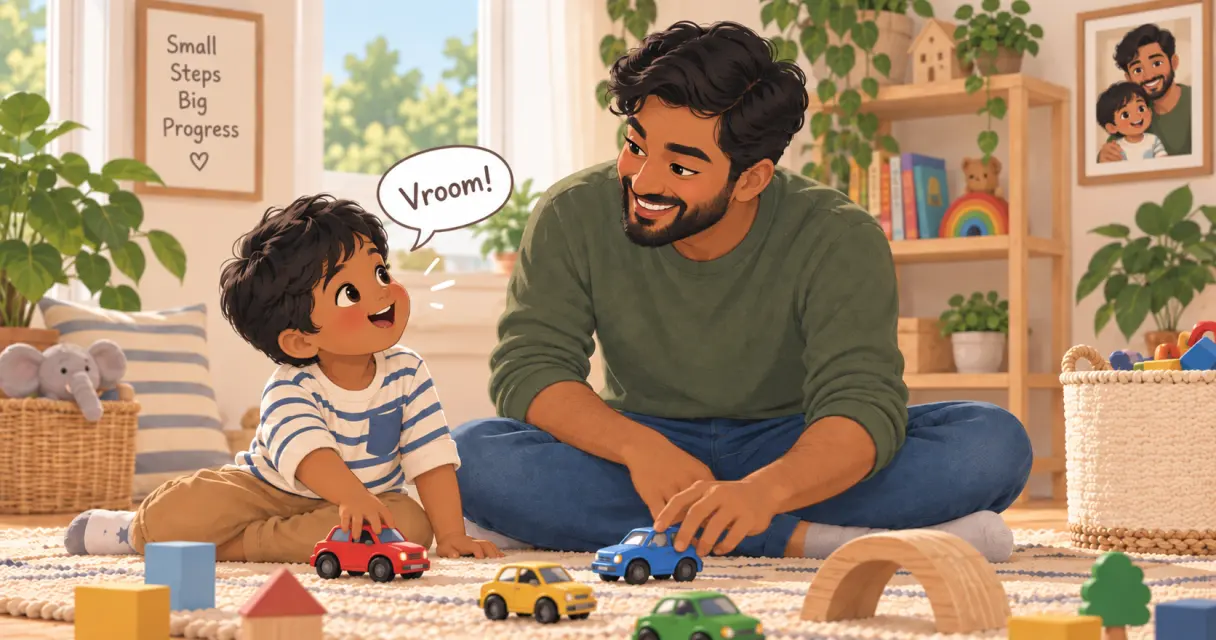
If they are pushing a car across the floor, talk about the car. If they are watching a dog outside, talk about the dog. If they keep opening and closing a cupboard, words such as open, close, in and out are probably more useful in that moment than trying to teach the name of something unrelated.
Language is easier to learn when the adult's words match the child's current focus of attention. Responsive caregiver strategies, including following the child's lead and responding to their communication, are commonly used in evidence-based early language interventions.
Try this
Your toddler rolls a car.
You: “Car!”
They roll it again.
You: “Car go!”
The car crashes.
You: “Crash!”
You have now modelled three useful words without asking your child to say anything.
2. Use simple language your child can learn from
Toddlers need to hear plenty of language, but more words in every sentence is not necessarily better. Instead, try to make some of your language particularly easy to notice.
If your toddler is not yet using words, model lots of useful single words:
- go
- more
- open
- up
- ball
- mummy
If they are beginning to use single words, start adding short combinations:
- car go
- more apple
- mummy help
- big ball
- door open
You do not need to speak in one- and two-word sentences all day. Continue talking naturally too. The shorter models simply give your child some language that is easier to pick out and eventually use themselves.
Focused language stimulation, repeatedly modelling selected words during meaningful activities, is one of the approaches supported in research with late-talking toddlers.
3. Comment more, test less
It is very easy for interactions with a late talker to turn into a string of questions: “What's that?” “What colour is it?” “What does the cow say?” “Can you say cow?”
Questions are not bad. But your toddler does not need to prove what they know every time you talk together. Often, simply tell them the word instead.
Instead of: “What's this?”
Try: “Cow! Moo!”
Instead of: “What is the boy doing?”
Try: “He's jumping!”
This gives your child a language model while keeping the interaction going.
4. Pause and give your toddler a turn
After you say something, leave a little space. Toddlers often need longer than adults expect to process what they heard and decide how to respond.
Your child's turn might be:
- looking at you
- pointing
- reaching
- making a sound
- copying an action
- signing
- attempting part of a word
- saying a word
You do not need to wait indefinitely or stare at them expectantly. Just create a noticeable pause before jumping in again.
Giving children adequate time to initiate and respond is specifically included among language-support strategies recommended for young children with late language emergence.
For example
You hold the bubble pot.
You: “Open.”
Pause.
Your toddler reaches towards it.
You: “Open! Let's open it.”
Then open the bubbles.
Their reach was communication. You responded to it and supplied the word they could eventually use.
5. Respond to communication, not just words
One of the most important changes parents can make is to notice communication that happens before speech.
If your child hands you a closed container, they may be asking for help. If they point towards the fridge, they may be requesting something. If they push their plate away, they may be telling you they are finished.
Put words onto those moments.
Child reaches up
You: “Up!”
Child gives you a container
You: “Help? I'll help.”
Child pushes their plate away
You: “All done.”
This is sometimes called linguistic mapping: giving language to the meaning the child is already communicating. Responding contingently to children's communication attempts is a central feature of caregiver-implemented language intervention.
And importantly, your toddler does not have to say the word before you help them.
6. Add one small step to what your child says
When your toddler says something, you can repeat it and add a little more information. This is often called an expansion.
Child: “Dog.”
You: “Big dog!” or “Dog running!”
Child: “More.”
You: “More banana.”
Child: “Daddy car.”
You: “Daddy's car!”
You are not correcting them or asking them to repeat the longer sentence. You are simply showing them what the next step could sound like.
Expansions and other responsive language models are widely used within parent-implemented interventions. Research has also found changes in parents' use of expansions to be associated with improvements in late talkers' expressive language.
7. Repeat useful words, but don't count them
Toddlers need to hear words many times and in meaningful situations before they are likely to use them themselves. You do not need to aim for exactly five, ten or twenty repetitions.
Instead, choose a useful word and let it appear naturally throughout an activity.
Playing with cars
“Car.” “Go!” “Car go.” “Go fast!” “Go again.”
Blowing bubbles
“Open.” “Open bubbles.” “Pop!” “More?” “More bubbles.”
This is the principle behind focused stimulation: giving children many opportunities to hear a target word without requiring them to imitate it. Focused stimulation and single-word modelling have evidence supporting their use with late talkers.
8. Use everyday routines
Some of the best language-learning opportunities happen during things you already do every day. There is no need to create a separate “therapy session”.
| Routine | Useful words and phrases |
|---|---|
| Snack | more, eat, open, drink, all done |
| Getting dressed | on, off, shoe, sock, help |
| Bath | in, out, wash, splash, more |
| Going out | shoes on, door open, let's go |
| Cars | go, stop, fast, crash, again |
| Bubbles | open, blow, pop, more, all done |
| Bedtime | book, up, night night, all done |
Natural, family-centred intervention embedded in children's everyday routines is a major feature of contemporary early-intervention practice.
For games built around these routines, and the words worth modelling in each, see twelve late talker activities to play at home.
9. Give choices when they are genuinely useful
Choices can make language easier because your child does not have to generate an answer from nothing.
At snack time you might hold up two options: “Banana or yoghurt?” Then wait.
Your toddler might say “banana”. But they might also point, reach, look at the banana or make a sound. That still counts.
You can respond: “Banana! You want banana.”
Choices should create an opportunity to communicate, not become a test they have to pass before receiving something.
10. Imitate your toddler too
Communication should go both ways. Try copying something your child does.
They bang two blocks together. You bang yours together.
They say: “Ba ba!” You say: “Ba ba!”
They laugh. You laugh.
Then you might add: “Bang!”
Imitation can help build shared attention and turn-taking, and responsive imitation is one of the interaction strategies used in early language intervention.
Sometimes joining your child's game first works much better than trying to redirect it.
11. Read together, but don't worry about finishing the book
Books are excellent for language development, but toddlers do not have to sit quietly while you read every sentence.
Let them:
- turn pages
- point at pictures
- skip pages
- make animal sounds
- repeat favourite pages
- choose the same book again
Talk about whatever catches their attention.
If your toddler points to a dog: “Dog!”
They say: “Dog.” You say: “Yes, dog running!”
Interactive or dialogic shared reading is also used in language interventions, including studies involving late talkers.
12. Don't make your child say the word first
A common piece of advice is to hold onto something your toddler wants until they say its name. You do not need to do this.
It is fine to create natural opportunities for communication, for example pausing before you blow more bubbles, but avoid turning the interaction into: “Say bubbles.” “Come on, say bubbles.” “You have to say bubbles first.”
Instead:
You: “More bubbles?”
Pause.
Your child reaches for the bubble pot.
You: “More! More bubbles.”
Then continue.
This teaches the meaning of more while showing your toddler that their existing communication works.
Language should become an increasingly useful option, not the price they have to pay to get what they need.
What about signs, gestures and pictures?
Use them.
Pointing, gestures, signs and pictures can all support communication while spoken language is developing. You can pair them with the spoken word:
- “More” + gesture
- “All done” + gesture
- pointing + “car”
Supporting communication in more than one way does not mean you are giving up on speech. ASHA notes that multimodal communication and AAC can be used with children with late language emergence, and AAC does not prevent spoken language from developing.
What if we speak more than one language?
Keep speaking the languages that are natural for your family. You do not need to switch to English-only because your child is late to talk.
Multilingualism does not cause language disorder, and reducing a child's exposure to a home language is not recommended simply because they have delayed language.
Use the language in which you can talk, play, joke, sing and connect most naturally.
A simple strategy to try today
Choose one routine your toddler already enjoys. Pick one or two useful words that fit naturally into it.
For example, during bubbles: open + more.
Then:
- Follow what your child is interested in.
- Model the word naturally: “Open!”
- Pause and give them a turn.
- Respond to whatever they do.
- Repeat the same little interaction when the opportunity comes up again.
That is enough. You do not need to turn your whole day into speech and language therapy.
If you are not sure which words to choose, the First Words Checklist is a good place to start, and the activity guide has twelve ready-made games to put them in.
Open the First Words Checklist
When should I speak to a speech and language therapist?
There is a wide range of typical early language development, and some children who talk later do catch up. However, it is worth seeking advice if you are concerned about your child's communication.
A commonly used criterion for late language emergence at around 24 months is fewer than 50 spoken words and no two-word combinations, but vocabulary size alone does not tell the whole story. Understanding, gestures, social communication, play, speech sounds and the child's rate of progress also matter.
Speak to a speech and language therapist, paediatrician or other appropriate professional if your child:
- is losing words or communication skills they previously had
- rarely uses gestures such as pointing or showing
- seems to have difficulty understanding everyday language
- is making very little progress with communication
- becomes very frustrated because they cannot communicate
- has possible hearing difficulties
- or you simply feel that something is not quite right
You do not need to wait until a delay becomes severe before asking for advice. A hearing check may also form part of the assessment process when language development is delayed.
The late talker screener can help you organise what you are seeing, and the appointment guide can help you prepare for the appointment itself.
The most important thing
Helping your toddler talk is not about collecting words they can produce for you on request.
It is about having lots of small interactions in which:
your child communicates → you notice → you respond → you add a little language.
Those tiny exchanges happen during snacks, baths, books, getting dressed, going outside and playing on the floor.
And because they happen again and again, they can add up to a lot of language-learning opportunities.
Want some help putting this into practice?
Knowing what to do is one thing. Remembering to do it during a busy day is harder.
SpeechBarn turns useful early words such as more, open, help, go, up and all done into playful activities you can do together: you model useful words, create natural communication opportunities, give your child time to respond and respond to every communication attempt, without turning play into practice.
Frequently asked questions
How can I encourage my toddler to talk?
Follow what your toddler is already interested in, say something simple about it, pause, and respond to whatever they do next. A look, gesture, sound, sign or word all count as their turn.
Should I make my toddler say the word before giving them what they want?
No. It is fine to pause and create an opportunity to communicate, but your child should not have to produce a spoken word to get something they need or enjoy. Respond to their gesture or sound, model the word, and carry on.
Is it better to ask questions or make comments?
Mostly comments. Questions are not harmful, but a string of them turns talking into a test. Instead of “What is this?” try “Cow! Moo!” Your child still hears the word, without the pressure.
How long should I wait after I say something?
Longer than feels natural. A few seconds gives your toddler time to process what they heard and decide how to respond. You do not need to wait indefinitely: just leave a noticeable pause before speaking again.
Do gestures and signs stop a child from talking?
No. Pointing, gestures, signs and pictures support communication while spoken language develops, and AAC does not prevent speech from developing. Pair them with the spoken word: “more” plus the gesture.
Should we speak only English at home?
No. Growing up with more than one language does not cause a language disorder, and reducing a home language is not recommended because a child is late to talk. Use the language you can play, joke and connect in most naturally.
How much practice does my toddler need each day?
You do not need a daily practice session. Choose one routine your child already enjoys, pick one or two useful words, and use them during that routine. Small, repeated interactions add up.
When should I speak to a speech and language therapist?
Ask for advice if your child is losing words or skills, rarely uses gestures, seems to have difficulty understanding, is making very little progress, is very frustrated, may have hearing difficulties, or you simply feel something is not quite right. You do not need to wait until a delay becomes severe.
Research behind this guide
This guide is informed by research into late language emergence and caregiver-implemented early language intervention, including systematic reviews and meta-analyses showing positive effects of parent-implemented intervention and evidence supporting responsive interaction, language modelling and focused stimulation.
Key sources include:
- Roberts & Kaiser (2011) on parent-implemented language intervention
- Cable & Domsch (2011) on treatment for late language emergence
- Carson, Baker & Munro (2022) on interventions for late talkers
- ASHA's evidence-based guidance on Late Language Emergence
This guide provides general information for parents and carers. It does not diagnose a speech or language difficulty or replace individual assessment and advice from a Speech and Language Therapist.
Clinically written and reviewed by a qualified Speech and Language Therapist.