Speech Sound Age Chart
A parent-friendly speech sound age chart explaining when kids usually learn sounds, what errors are common, and when to ask for help.
Educational content for parents. SpeechBarn supports at-home practice and does not replace a speech-language pathologist.
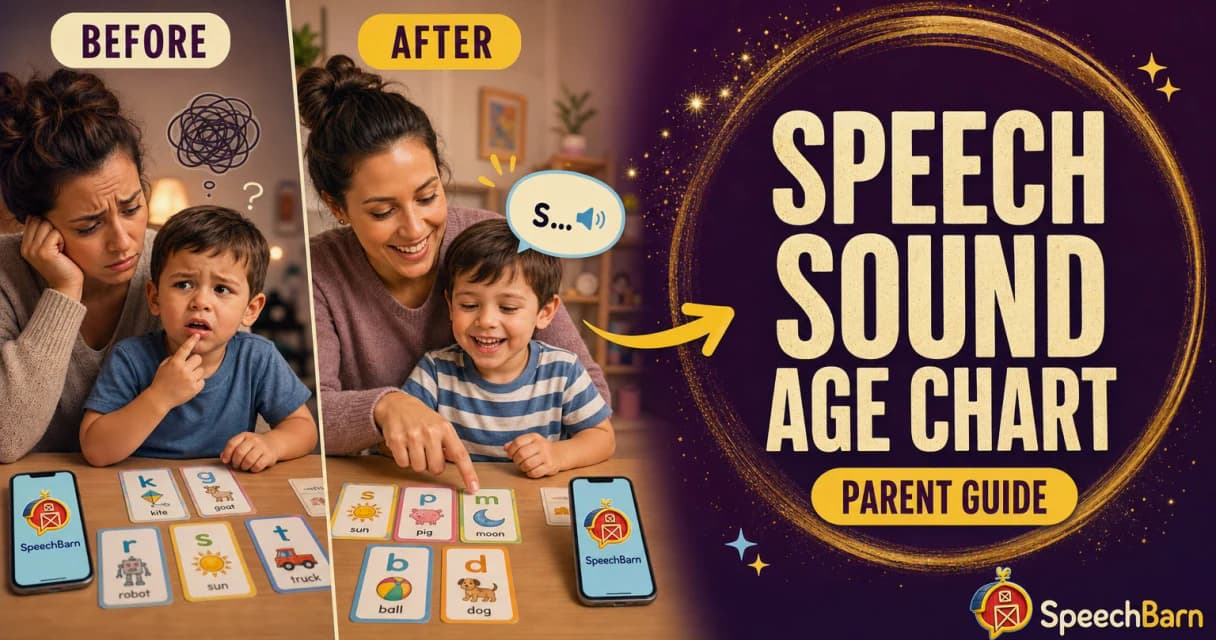
A speech sound age chart can help you understand whether a sound is still developing or worth asking about. It should not be used to diagnose a child from one word at the kitchen table.
The most useful question is not "Can my child say this sound once?" It is "Can my child use this sound clearly enough across words, people, and everyday situations?"
A speech sound chart is a guide, not a diagnosis. Use it to notice patterns and decide what to ask an SLP.
- Sound development is gradual. Many children use a sound in one word before they can use it everywhere.
- Look for patterns: omitted final sounds, sound substitutions, or sounds that disappear in longer words.
- Intelligibility matters. How easily familiar and unfamiliar adults understand your child is important context.
- Use a checklist to prepare examples instead of trying to diagnose from one chart.
How to listen without overcorrecting
A chart can make parents want to correct every word. A better home move is to listen for patterns and model the word clearly.
"I heard tar. I am saying car. Car goes fast."
"That was a good try. Listen: sssun."
"Let's put that word on our list for practice."
"I understood you. I am going to say it back clearly."
How to read a sound chart
Most charts show the age when many children can produce a sound accurately. They do not mean every child must master the sound on their birthday.
Look for patterns. A single hard sound is different from many unclear sounds, frustration, or difficulty being understood by familiar adults.
Sounds that often come earlier
- /p/, /b/, and /m/ because they are visible lip sounds.
- /t/, /d/, /n/, and /h/ in many simple words.
- /k/ and /g/ for many children, though fronting can happen.
- Vowels and simple word shapes before clusters like /sp/ or /tr/.
Sounds that often take longer
Later sounds often include /r/, voiced and voiceless th, /l/, /s/, /z/, sh, ch, and blends. Some are hard because they need precise tongue placement or because the child cannot see the movement.
If your child is frustrated or very hard to understand, ask for professional guidance even if one specific sound is still age-typical.
What to track from a speech sound chart
Write examples down for one week. Patterns are more useful than one perfect or imperfect word.
| What you notice | Example note | Why it helps |
|---|---|---|
| Sound substitution | Says "tat" for "cat" | Shows which sounds may need practice or evaluation. |
| Final consonant missing | Says "ca" for "cat" | Helps identify word-shape patterns. |
| Sound works sometimes | Can say /s/ in sun but not spoon | Shows whether blends or word position are harder. |
| Long words break down | Short words clear, longer words harder | Gives useful context for an SLP. |
| Unfamiliar listeners struggle | Grandparent understands less than parent | Connects sounds to real communication impact. |
Pick one sound your child is close to saying. Practice it in easy words before harder words.
Open sound checklistA child may make a sound alone but lose it in a word. That is useful information, not failure.
Bring five real words your child says often. Real words help more than a vague concern like "speech is unclear."
What to note before an evaluation
- Which sounds are missing or swapped.
- Whether the error happens at the start, middle, or end of words.
- Whether familiar adults understand the child.
- Whether your child avoids words or gets frustrated.
- Examples of words your child says clearly and unclearly.
When a sound chart should lead to help
- Ask for professional guidance if your child is hard to understand, frustrated by communication, missing many sounds for their age, or showing patterns that are not changing.
- A speech-language pathologist can interpret age, intelligibility, oral structure, hearing history, and error patterns together.
Keep going with SpeechBarn
SpeechBarn turns short parent-led practice into a playful sound-it-out game. Use the free tools below, then build a child speech plan when you want a more structured routine.
SpeechBarn content is educational and is not a diagnosis or a replacement for care from a speech-language pathologist.
Frequently asked questions
What age should a child say R?
R is often later-developing. Timelines vary, so look at overall clarity, frustration, and professional guidance rather than one sound alone.
Are speech sound charts diagnostic?
No. Charts are screening and education tools. A speech-language pathologist can evaluate speech patterns in context.
What if my child can say a sound sometimes?
That can be a good sign. Practice usually focuses on moving from one successful word to using the sound across many words and situations.