Late Talker Activities: 12 Games to Play at Home
Twelve late talker activities and games to play at home, the words worth modelling in each one, and the everyday routines that already do the same job.
Educational content for parents. SpeechBarn supports at-home practice and does not replace a speech and language therapist.

If your toddler isn't saying as much as you expected, the hardest part is often knowing what to actually do with them today.
You do not need flashcards, worksheets or special equipment. Most of the best early language activities use things you already have: a ball, a box, a bag of blocks, a doll, a tap and a book.
Below are twelve games to play, the words worth modelling in each one, and the everyday routines that are already language lessons if you use them that way.
The game matters less than what you do inside it. The same five minutes of blocks can be a test or a conversation, depending on who is leading and how long you wait.
What is a “late talker”?
“Late talker” is an informal term often used for a young child who is using fewer spoken words or word combinations than expected for their age. It isn't a diagnosis.
Some children who are late to talk understand language very well and mainly have difficulty using words themselves. Others may also find it harder to understand language, use gestures, interact, play, learn new words or combine them.
If you are concerned, a Speech and Language Therapist (SLT) can look at the whole communication picture, rather than simply counting how many words your child says. The late talker screener can help you organise what you are seeing beforehand.
The five moves that make any activity work
Every game below uses the same handful of moves. They are worth knowing before you start, because they are what turns play into language practice.
- Follow: play the game the way your child wants to play it.
- Model: say the useful word yourself, often, without asking them to repeat it.
- Pause: stop and leave a gap that feels slightly too long.
- Respond: treat a look, reach, point, sound or sign as their turn, and answer it.
- Add: give back what they communicated plus one word.
If you want the reasoning behind each one, and the research it comes from, read how to help a toddler talk. This guide assumes them and gets on with the games.
How to use this list
Do not try twelve activities this week. Choose one or two, and play them repeatedly for several days.
Repetition is the point: a word your child hears in the same situation on Monday, Tuesday and Wednesday is far easier to learn than twelve words heard once each.
The words listed with each game are suggestions, not a curriculum. Pick the one or two that would be genuinely useful to your child. The First Words Checklist can help you choose.
The twelve activities at a glance
| Activity | Words to model | The move that matters |
|---|---|---|
| 1. Ready, steady… go! | ready, go, again, stop | Pause on “steady…” |
| 2. Tower and crash | up, more, uh-oh, crash, again | Wait before you knock it down |
| 3. Posting game | in, more, gone, all done | Hand over one piece at a time |
| 4. Bubbles | open, blow, pop, more | Close the lid and wait |
| 5. Balloon up and down | up, down, my turn, pop | Hold the balloon and look |
| 6. Hide and find | where, gone, boo, found it | Let them do the finding |
| 7. Animals on the farm | animal sounds, in, out, eat, sleep | Copy their sound first |
| 8. Wind-up and pop-up toys | help, open, again, oh no | Hand it back unwound |
| 9. Silly mistakes | no, not that, silly, shoe | Get it obviously wrong |
| 10. Teddy's snack | eat, drink, more, all done | Offer teddy the empty cup |
| 11. Song pauses | the last word of each line | Stop singing and look |
| 12. Water at the sink | in, out, pour, wet, more | Give one cup, not five |
1. Ready, steady… go!
You need: a ball, a toy car and a ramp, a slide, or your own arms.
Words to model: ready, go, again, stop, fast
Hold the ball at the top of the ramp. Say: “Ready… steady…” Then stop.
Look at your child and wait. They may look back, wriggle, reach, make a sound, gesture or eventually say “go”.
Whatever they do, answer it: “GO!” and release the ball.
The reason this game works so well is that your child already knows what is coming. The word has an obvious job, it arrives at the same moment every time, and the game itself is the reward.
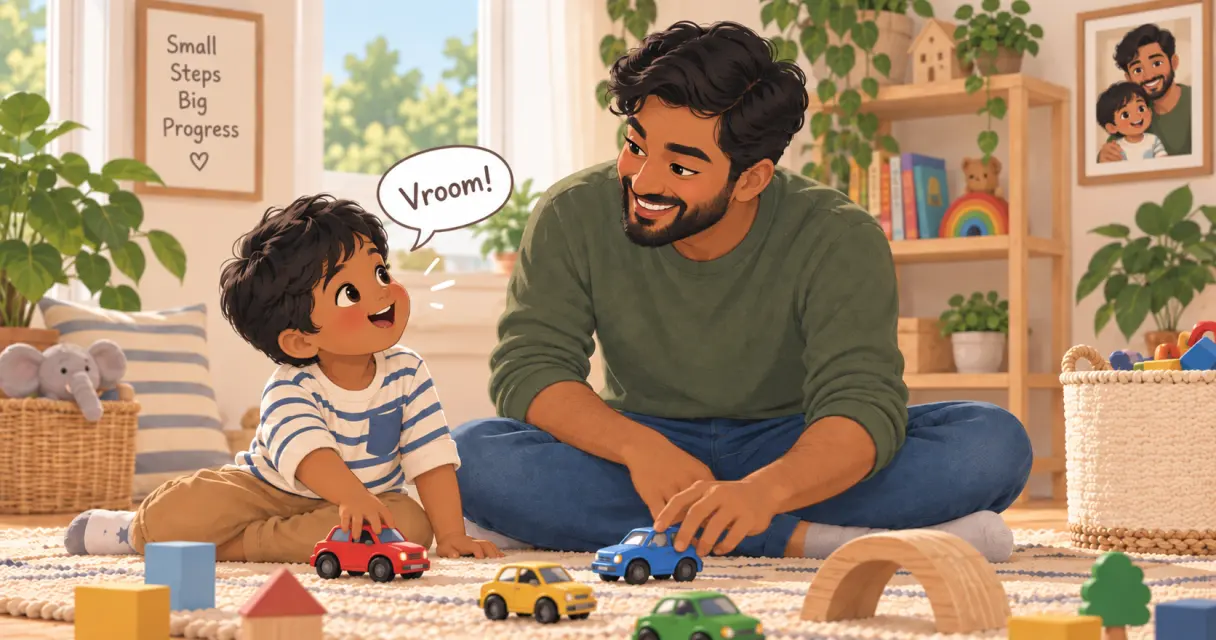
It works with anything that can be launched, pushed, swung or dropped, and once “go” is familiar, the same pause teaches again, stop, up and down.
2. Tower and crash
You need: blocks, cups, or anything stackable.
Words to model: up, more, uh-oh, crash, again, build
Build a tower together, one block at a time, saying “up… up… up” as it grows.
Then stop with your hand ready beside it and look at your child.
Most toddlers will tell you exactly what they want to happen next, with a push, a shout, a grin or a word. Say “Crash!” as it falls, then “Again?” and start building.
Hand the blocks over one at a time rather than tipping the whole box out. Each one is another natural moment for more.
3. Posting game
You need: a box with a slot cut in the lid, a piggy bank, or a shape sorter. Post coins, lids, counters, pasta or cut-up card.
Words to model: in, more, gone, all done, my turn
Toddlers will post things for a surprisingly long time, which makes this one of the best repetition games there is.
Hold the pieces yourself and give them out one at a time, saying “in” each time one drops.
When the pieces run out: “All gone! More?” Then pause before you open the box and start again.
You will model in twenty or thirty times in five minutes without ever asking your child to say it.
4. Bubbles
You need: bubbles, and a lid that is stiff enough that you have to open it.
Words to model: open, blow, pop, more, up, gone
Blow a few bubbles. Then screw the lid back on, hold the pot, and wait.
Your child might look at the pot, look at you, reach, point, bounce, sign or say something. Respond to whatever it is: “More! More bubbles.” Then blow again.
Pop the bubbles together and say “Pop!” every time. Short, repeated, easy-to-notice words attached to something genuinely exciting are what early vocabulary is built from.
If your child doesn't communicate after the pause, that's fine: model it yourself and carry on. The pause is an opportunity, not a test they have to pass.
5. Balloon up and down
You need: one balloon. Stay with your child while you play.
Words to model: up, down, my turn, your turn, pop, blow
Balloons move slowly, which gives a toddler time to look, react and take a turn: the same event in slow motion.
Bat it up: “Up!” Watch it fall: “Down!” Hold it against your chest and look at your child before the next hit.
Blowing the balloon up and letting it go is even better: hold the inflated balloon, pause, and let their reaction be what launches it.
6. Hide and find
You need: a favourite small toy and a cup, a tea towel or a box. Or nothing at all, for peekaboo.
Words to model: where, gone, boo, there, found it, look
Hide the toy under one of two cups while your child watches. Say “Gone!” Then wait.
Let them lift the cup. When they find it: “There it is! You found it.”
Hiding under a cloth and pulling it away teaches gone and boo; hiding yourself behind a door teaches the same words with your whole body, which many toddlers find funnier.
7. Animals on the farm
You need: toy animals, a farm or a box for a barn, duplo, or animal pictures.
Words to model: moo, baa, quack, oink, in, out, eat, sleep, jump, more
Animal noises are often easier for early communicators than words, and they count: they are sounds used on purpose to mean something.
Copy your child's sound before you add your own: if they say “baa”, say “baa!” back, then “Baa! Sheep.”
Put the animals in the barn and take them out: “In… in… out!” Feed them, put them to sleep, make them jump. Each little routine is another reason to say the same few words again.
8. Wind-up and pop-up toys
You need: a wind-up toy, a jack-in-the-box, a pop-up toy, or a bottle of something with a tight lid.
Words to model: help, open, again, ready, oh no, go
Help is one of the most useful words a toddler can have, and a toy they cannot operate alone is the most natural place to teach it.
Wind it up, let it run, then hand it back unwound and wait.
When your child gives it to you, looks at you or makes a sound, put the word on it: “Help! You need help.” Then help them straight away.
They do not need to say “help” first. Hearing it in exactly the moment it is useful, over and over, is what makes it learnable.
9. Silly mistakes
You need: nothing. Just get things obviously wrong.
Words to model: no, not that, silly, shoe, uh-oh, mummy's
Put your child's sock on your hand: “Sock on my hand!” Try to give them a spoon when they clearly want their shoe. Pretend to drink from an empty cup. Put the toy cow in the bath.
Then pause, and look genuinely puzzled.
Toddlers who rarely initiate will often protest, laugh, shake their head, point at the right thing or show you what you should have done. All of that is communication, and you get to supply the words: “No! Not spoon. Shoe! You need your shoe.”
Something interesting has gone wrong, so there is a real reason to tell you about it, which is a much better prompt than a question.
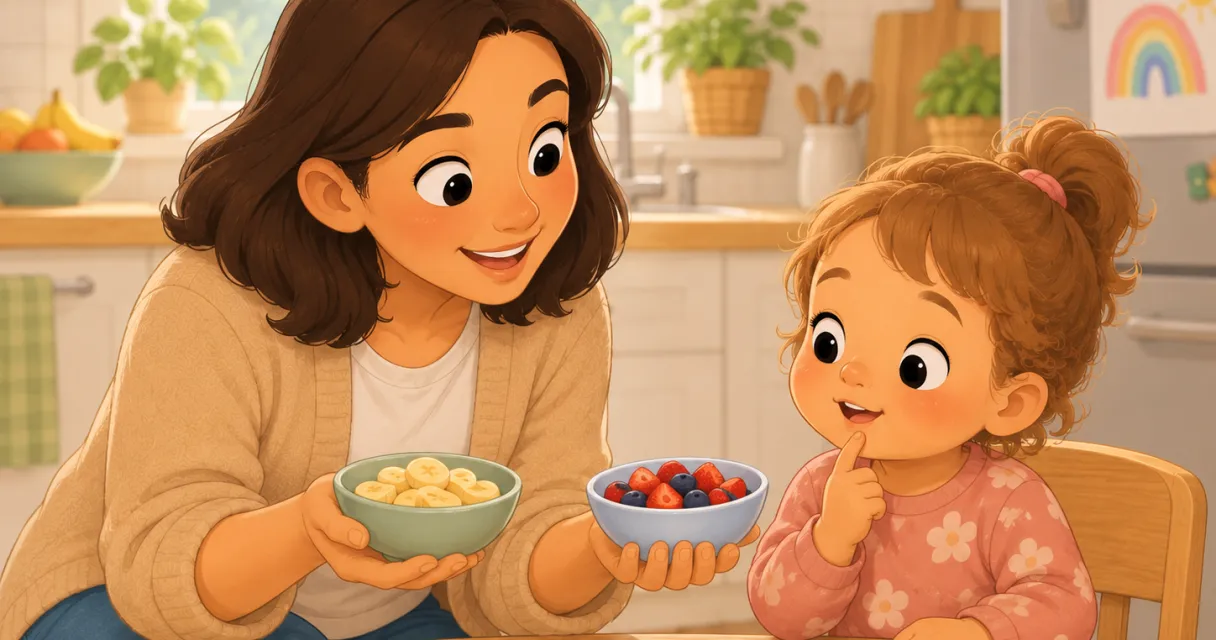
10. Teddy's snack
You need: a doll or teddy, a cup, a bowl, a spoon. Real or pretend food both work.
Words to model: eat, drink, more, all done, yum, night night, hungry
Feed teddy together and narrate it: “Teddy's eating. More? More banana. All done!”
Pretend play and language grow together, and the words here are the same ones your child needs at their own mealtimes, practised somewhere with no pressure attached.
Offer teddy the empty cup and look confused, or let teddy try to eat a block, and you have a silly mistake inside a pretend game.
11. Song pauses
You need: the songs you already sing. Actions help.
Words to model: the predictable last word of each line (go, up, down, pop, again, more)
Sing a familiar song, then stop just before the word your child is waiting for: “Twinkle, twinkle, little…”
Wait. Look at them. Raise your eyebrows.
They may fill it in, make a sound, do the action, smile or look at you to start again. Any of those is a turn. Finish the line and carry on.
Songs with a big obvious moment work best: the pop in Pop Goes the Weasel, the fall in Ring o' Roses, the “wheeee” of a rocket. Stopping the song is also a natural way to teach more and again.
12. Water at the sink
You need: a washing-up bowl or the sink, one cup, a jug, a sieve, a few bath toys.
Words to model: in, out, pour, wet, more, splash, uh-oh
Give your child one cup rather than everything at once. The rest stay with you, which means every new item is a reason to communicate.
Pour water over their hands: “Pour! More?” Drop a toy in: “In!” Tip it out: “Out!”
Water play is slow, repetitive and hard to get wrong, which makes it a good one for days when nobody has much patience left.
Routines that are already activities
You do not have to set aside playtime to do any of this. The routines you repeat every day are the most reliable language practice your child gets, because they happen whether you planned them or not.
| Routine | Words to model | Where the opportunity is |
|---|---|---|
| Snack | more, eat, open, drink, all done | Hold up two things and offer a real choice |
| Getting dressed | on, off, shoe, sock, arm, up | Pause with the sock in your hand |
| Bath | in, out, wash, splash, more, all done | Wash one body part at a time and name it |
| Tidying up | in, more, put in, all done | Hand over toys one at a time |
| Out the door | shoes on, door open, let's go, bye | Wait at the closed door before opening it |
| Bedtime | book, up, night night, again | Pause on the last page of the same book |
Pick one routine and use the same two words in it every single day for a week. That is more useful than doing all six once.
A note on books
Books belong on this list, but not as reading practice.
Let your toddler turn the pages, skip to the tractor, point at things, make the noises and choose the same book for the fortieth time. Talk about whatever they are looking at rather than finishing the sentence you are on.
If they point at the dog, that is their turn: “Dog! Big dog running.”
A board book your child leads you through beats a longer story they sat politely through.
If an activity isn't working
They won't join in
Join them instead. Play whatever they are already doing, alongside them, without redirecting, even if it is opening and closing the bin lid. The activity you chose is less important than being in the same game.
They lose interest after a minute
That is normal. Two good minutes repeated four times in a day is better than one long session that ends badly. Stop while it is still fun.
They don't copy me
They do not need to. You may model “more” dozens of times before your child ever uses it, and every one of those times teaches them what it means and what it does. Imitation is not the point of modelling.
They get frustrated
Drop the pause for a while and simply play, modelling words as you go. Never hold something your child needs until they say a word for it. See why the word should not be the price.
They say it unclearly
Respond to the message and model the word clearly yourself: “Tat!” → “Cat! Yes, a cat.” No correcting, no “try again”.
What progress looks like
Progress is not only “how many new words did they say?”
Earlier signs that these activities are doing something include your child looking at you more during games, starting a game themselves, bringing you the bubble pot, taking more turns before wandering off, copying an action or a sound, protesting when you get it wrong, using a gesture and a sound together, or getting less frustrated because more of their messages are landing.
Early communication develops in a lot of small steps, and the ones before words are the ones worth noticing first. The speech milestones checklist puts them in order.
When should I ask for help?
You do not have to wait until your child reaches a particular age if you are worried about their communication.
Speak to your health visitor, GP or a Speech and Language Therapist if you have concerns about your child's talking, understanding, gestures, interaction, play, speech clarity, hearing or overall development, or if they are becoming increasingly frustrated because they cannot communicate what they need.
Seek advice sooner if your child stops using words or skills they previously had, rather than waiting to see whether they come back. Hearing difficulties can also affect speech and language development, so ask about a hearing check if your child does not always respond to sounds or has frequent ear problems.
There is more detail on what a therapist will want to know, and what the research says about late talkers, in how to help a toddler talk.
Your week, in one line
Choose one activity and one routine. Choose two words. Play them every day, follow your child, model the words, pause, and answer whatever comes back.
That is the whole plan. It is meant to be small enough that you will actually do it.
Want some help putting this into practice?
Knowing what to play is one thing. Remembering to follow, model, pause and respond while you are doing it is harder.
SpeechBarn turns useful early words such as more, open, help, go, up and all done into playful activities you can do together, so your child plays, you model, and communication stays low-pressure.
Frequently asked questions
What activities help a late talker?
Simple, repetitive games where the same useful word comes up again and again: ready-steady-go, posting games, bubbles, tower and crash, hide and find, wind-up toys and song pauses. The game matters less than following your child, modelling the word, pausing and responding to whatever they do.
Do I need special toys or flashcards?
No. A ball, a box with a slot in it, blocks, a teddy, a balloon and the kitchen sink cover almost everything in this guide. Flashcards are not needed for early language.
How many activities should I do at once?
One or two, repeated for several days. A word your child hears in the same situation all week is much easier to learn than twelve words heard once each.
How long should we play for?
Two or three good minutes is plenty, several times a day. Stop while it is still fun rather than pushing on until it goes wrong.
My toddler will not join in the activity. What should I do?
Join theirs instead. Play alongside whatever they have chosen, even if it is opening and closing a cupboard, and model words for that. Being in the same game matters more than which game it is.
Should I make my child say the word before giving them the toy?
No. Pausing to create an opportunity is helpful, but your child should not have to produce a word to get something they want or need. Respond to their gesture or sound, model the word, and carry on.
What if my child does not copy me?
They do not need to. You may model a word dozens of times before your child uses it, and each time still teaches them what it means and what it does.
When should I see a Speech and Language Therapist?
Seek advice if you are worried about your child’s communication, particularly if you also have concerns about understanding, gestures, interaction, play, hearing or overall development. Ask sooner if your child has stopped using words or skills they previously had.
About this guide
This guide provides general information for parents and carers. It does not diagnose a speech or language difficulty or replace individual assessment and advice from a Speech and Language Therapist.
Every child develops differently, and the right support depends on the child's individual communication profile.
Guidance informing this resource
This resource reflects established early-language strategies recommended by organisations including:
- Speech and Language UK
- NHS children's Speech and Language Therapy services
- the Royal College of Speech and Language Therapists (RCSLT)
Clinically written and reviewed by a qualified Speech and Language Therapist.