Phonological Awareness Activities
Phonological and phonemic awareness activities for parents: rhyming, syllables, sound matching, blending, and playful listening games.
Educational content for parents. SpeechBarn supports at-home practice and does not replace a speech-language pathologist.
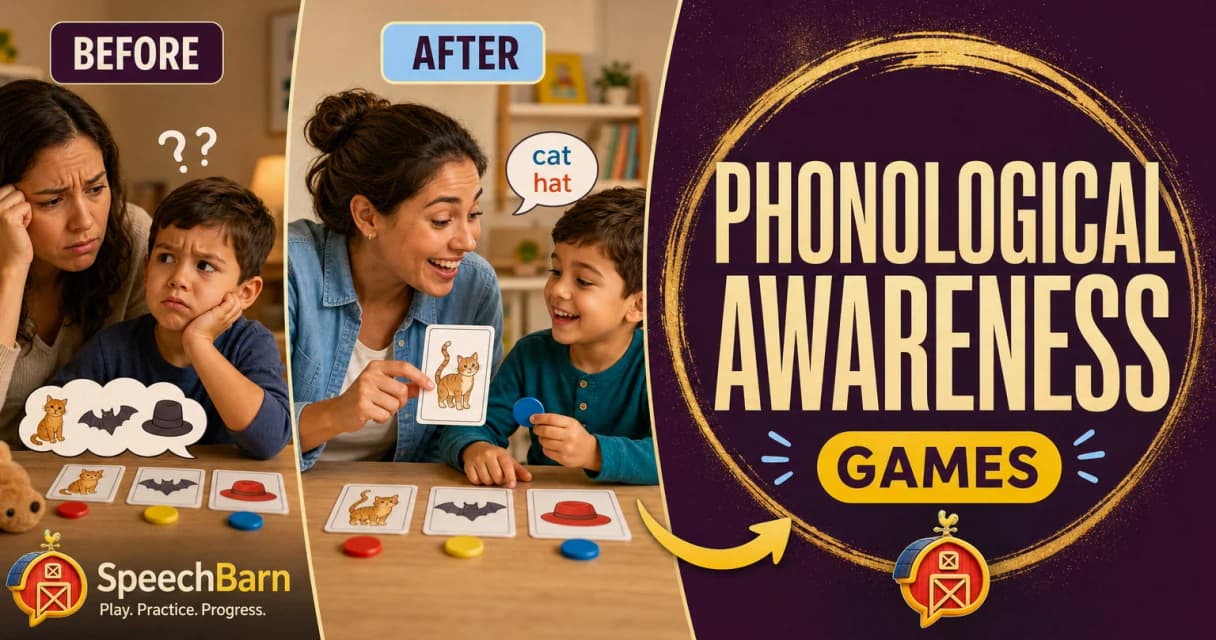
Phonological awareness is the ability to notice and play with sounds in spoken language. It includes rhyming, syllables, first sounds, blending, and segmenting.
You can build it with games long before a child is ready for formal reading worksheets.
Phonological awareness is playing with the sounds in words: rhymes, syllables, first sounds, and sound blending.
- Start with listening games before asking for letters.
- Rhyming and syllable clapping are easier than segmenting every sound in a word.
- Keep it oral and playful. This is not a worksheet-first skill.
- Short games can support both speech practice and early reading readiness.
Sound-awareness scripts parents can use
These scripts keep the focus on hearing and playing with sounds, not spelling.
"Cat, hat. They rhyme. Cat, banana. Not a rhyme."
"Clap rainbow: rain-bow. Two beats."
"What starts like sun? Snake starts like sun."
"I will blend it: mmm-oon. Moon."
Start with bigger sound chunks
Many children notice syllables and rhymes before individual sounds. Clap names, stomp animal syllables, and make silly rhyming strings.
If a child struggles with first sounds, back up to rhyming and syllables instead of pushing harder.
Games to try
- Rhyming basket: find things that rhyme with cat, ball, or bee.
- Syllable jumps: jump once for each beat in a word.
- First sound hunt: find things that start like mom or sun.
- Blend the robot: say /m/ /oo/ /n/ and let your child guess moon.
- Sound switch: change mat to sat and act out the meaning change.
- Odd one out: dog, duck, sun - which starts differently?
How this connects to speech
Sound awareness supports both speech and early literacy. A child who hears the difference between sounds has a stronger base for practicing them.
Pair this guide with minimal pairs when the goal is noticing one speech sound contrast.
Skill ladder for sound-awareness games
If a game feels too hard, move one row up the ladder. Easier practice often leads to better participation.
| Skill | Example game | Make it easier by... |
|---|---|---|
| Rhyming recognition | Do cat and hat rhyme? | Use two pictures and exaggerate the ending. |
| Syllables | Clap dinosaur | Start with names and favorite foods. |
| First sound | Find things that start with /m/ | Use one sound and three obvious objects. |
| Blending | Guess sss-un | Use words with two or three sounds. |
| Segmenting | Say the sounds in map | Use chips or blocks to show each sound. |
Children can practice sound awareness in the car, at bath time, or during snack without looking at letters.
Play the gameSilly rhymes can be fun, but real words are easier when a child is just starting.
If your child is practicing /s/, look for /s/ words in a sound-awareness game too.
Order of difficulty
- Rhyming.
- Syllable clapping.
- First sound matching.
- Blending sounds into words.
- Segmenting words into sounds.
When sound-awareness games are too hard
- If your child cannot hear rhymes or syllables after many playful attempts, keep the games easier and ask a teacher, reading specialist, or SLP for guidance.
- Avoid turning early literacy into pressure. The goal is curiosity about sounds.
Keep going with SpeechBarn
SpeechBarn turns short parent-led practice into a playful sound-it-out game. Use the free tools below, then build a child speech plan when you want a more structured routine.
SpeechBarn content is educational and is not a diagnosis or a replacement for care from a speech-language pathologist.
Frequently asked questions
What is an example of a phonemic awareness activity?
Blending /s/ /u/ /n/ into sun or identifying the first sound in mom are phonemic awareness activities.
What is the difference between phonological and phonemic awareness?
Phonological awareness is the broader skill of noticing sound parts. Phonemic awareness focuses on individual sounds.
Can preschoolers do phonological awareness games?
Yes. Keep games oral, playful, and short. Rhyming and syllable games are a good start.